Chuck
A downloadable game for Windows, macOS, and Linux
Forty floors. One way up.
Ellen Ross wrote the access system for Kessler Tower and works nights as its duty controller. At 00:12 she is three blocks from work with a coffee in her hand and her husband twenty metres behind her on the pavement when an SUV comes up the kerb lane with its lights off. Two men in maintenance coveralls put her in it. Nobody comes, because eight minutes earlier every unit in the city was sent somewhere else.
Chuck follows them across a cordon he does not yet understand and watches them walk her in through the tower's own front door at 00:22. He goes in after them.
What is happening inside is not a kidnapping. Twelve men have been badged into this building since March as its night maintenance contractor, and the flight cases they wheeled through the goods entrance were never inspected. The demand they broadcast at 00:04 is theatre: it put every unit in the city on a cordon around this building and nobody at all inside it. The sub-vault opens on the overnight settlement, and its seventh and last lock runs on a two-key rule, the bank's key, and the building's duty controller, alive and present.
That is why they needed Ellen, and it is the only reason she still is. At 01:00 the bonds leave the roof.
What you actually do
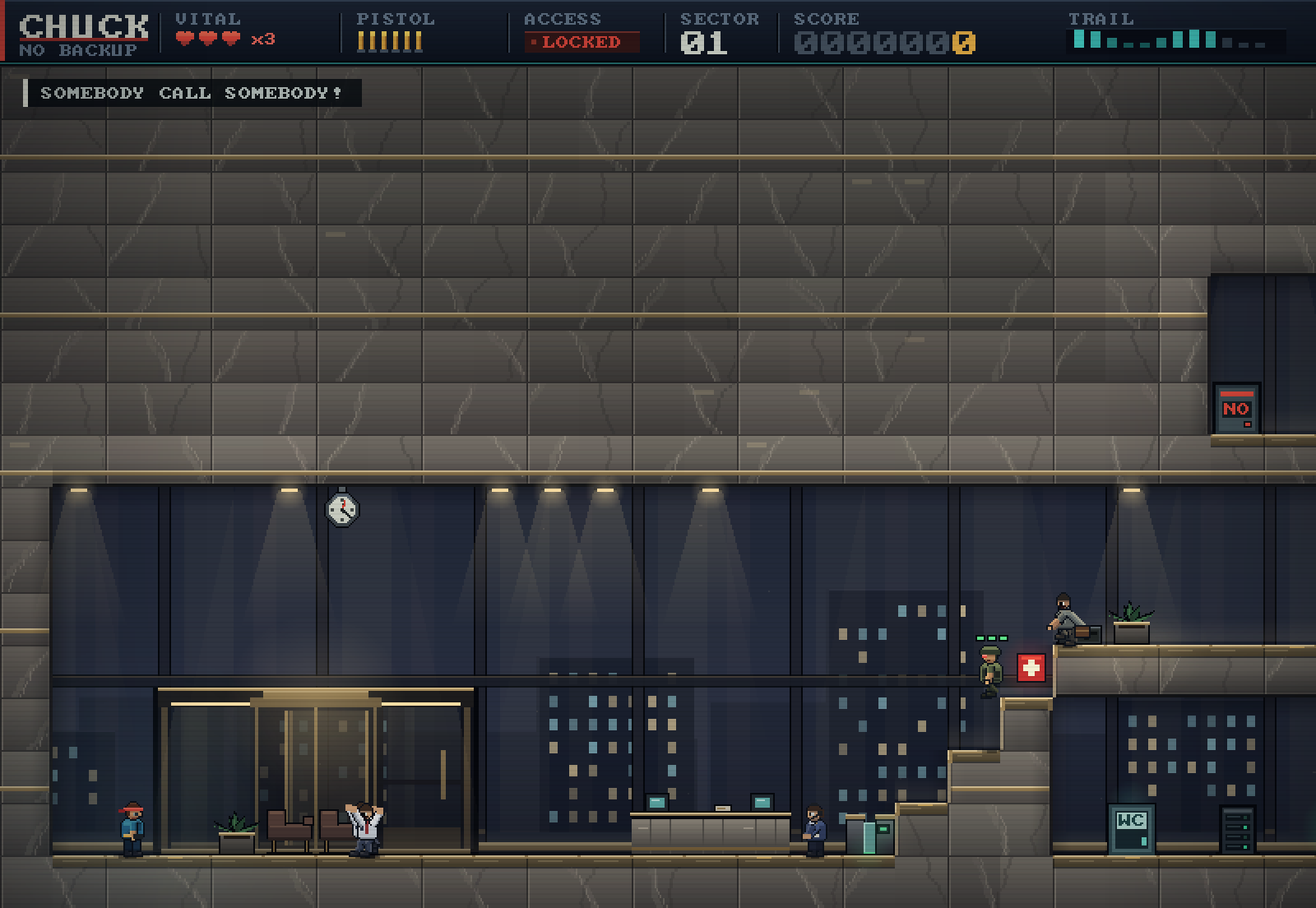
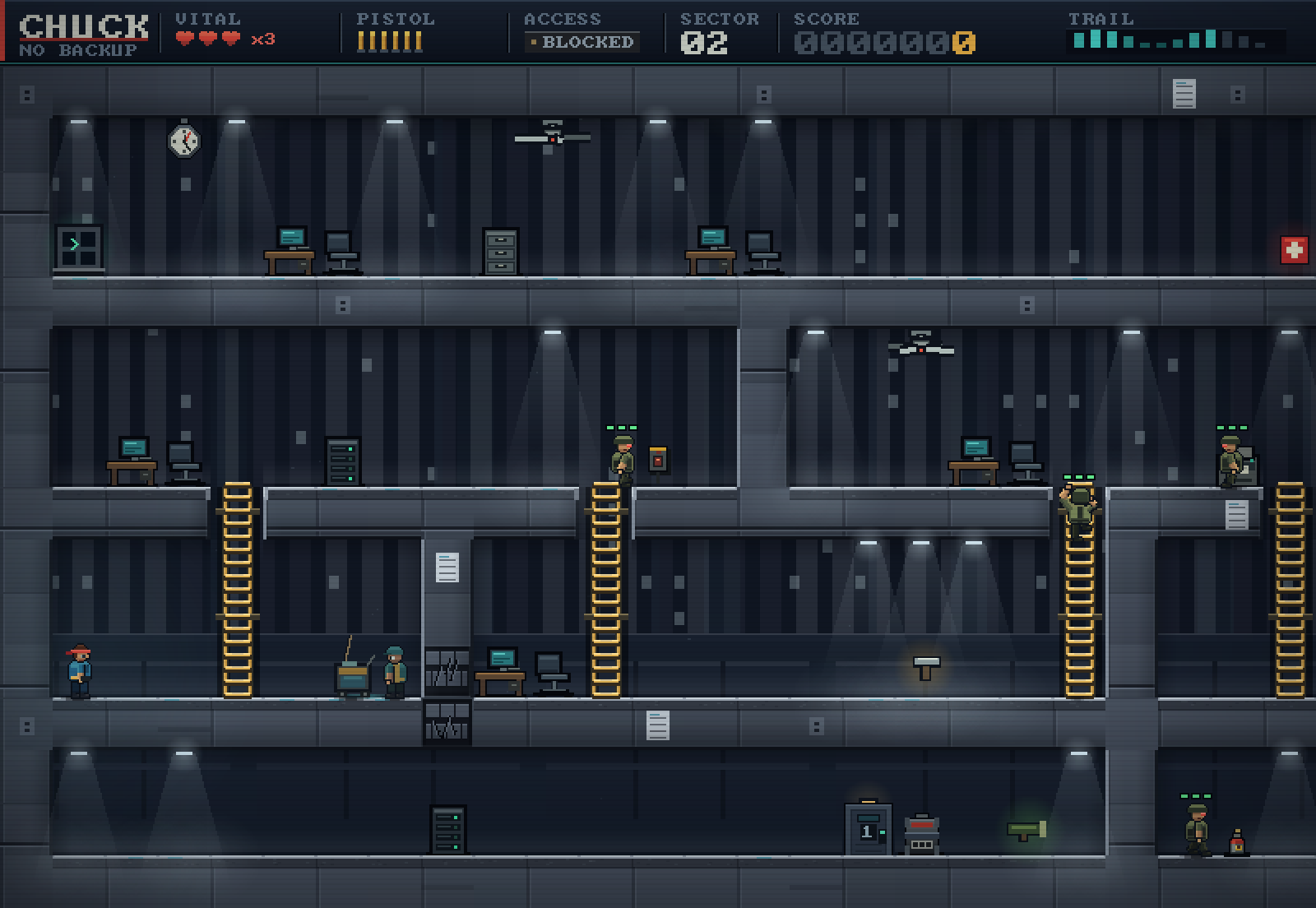
Seventeen sectors between the lobby and the roof, each one a small infiltration route: find the key card or breach the security terminal that opens the way deeper in, and decide floor by floor when to fight, when to walk past, and when to let the building do it for you.
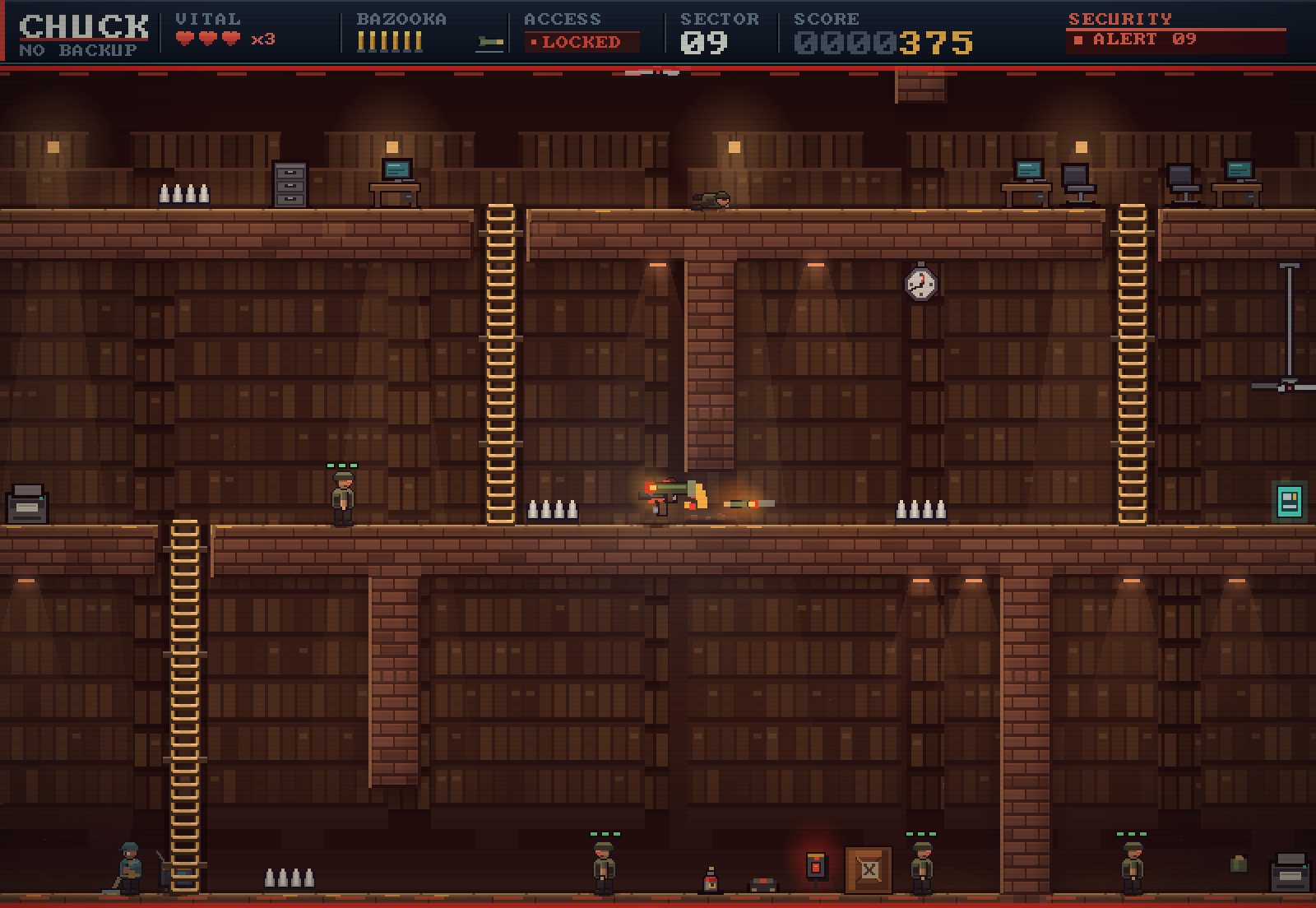
- Guards that look, listen and remember. They see through a forward cone that walls, floors and crates block, so they can spot you diagonally or up a ladder shaft and fire straight down it. Gunfire draws the nearest of them over to look. One who finds a body often sprints for a wall switch, and the fallen stay where they drop, so where you leave one is a decision as real as where you fought.
- A quiet way through, and it is three things. A knife takes a man down in one stroke from behind, provided nobody has seen him and the alarm is down. A pocket of bolts that never runs out makes a noise somewhere else and calm guards walk to the noise instead of to you. And a body can be dragged out of the room it fell in, at half speed, no ladders, no jumping.
- An alarm that changes the floor rather than ending it. Red light, every guard and dog moving, rounds led ahead of a runner, gaps hopped to keep up, a sweep around where you were last seen, and it switches itself off once you have been out of sight long enough.
- Answers to being seen. A flash charge kills nobody: it takes the sight out of every guard near it for a few seconds and makes any camera in reach forget what it had. Then they carry on exactly as they were. It buys seconds, and the seconds are for leaving.
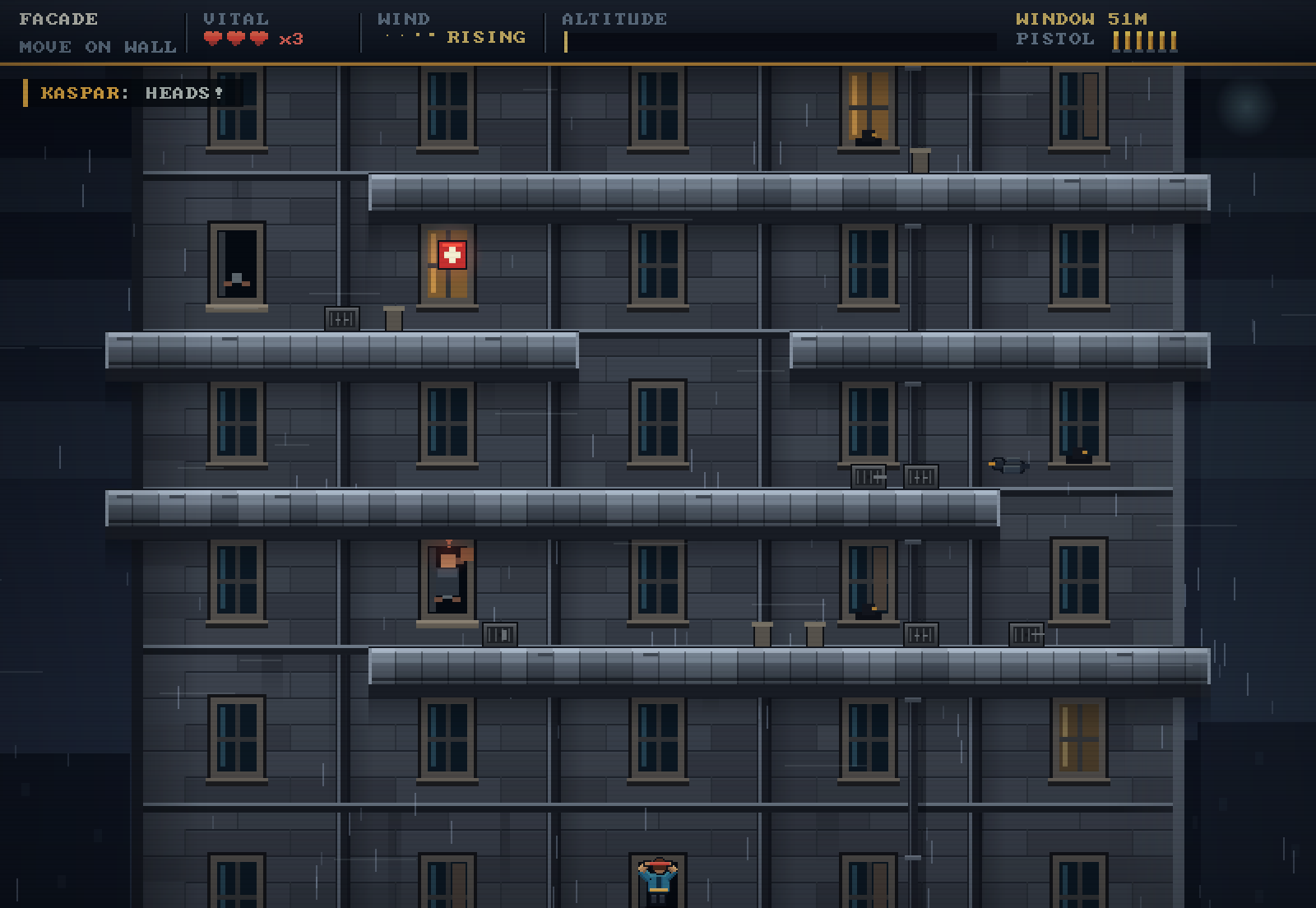
- Five sectors that are not walked at all. The stair door is welded, the way on is an open window, and out there gravity and ladders are replaced by four-way movement across the brickwork. Cornices are the obstacle and the only cover, a building-wide wind howls before it shoves, men lean out of windows and shout before they throw, and birds cross at you. What you carry up is what you have inside the next floor.
- The crew talk, and you can read it. Twelve men run this night like a shift. A guard on his own calls in, two standing together chat instead, whoever reaches a switch shouts. Stand close enough and the line prints under the HUD with the speaker's callsign on it. The locks on the vault, the cordon outside, the clock and how many of them are still answering all get said out loud by the men doing it, none of it in a screen you have to stop playing to read.
What it remembers
Three hearts a life, and one rule: what hits you costs hearts, what crushes you or breaks your fall kills you. Progress inside a floor is banked, so a death resumes at the last card, hack, door or medkit rather than at the stairs, and the world keeps its dead guards and its opened walls. Running out of lives always offers the same sector back; the game never sends you to the lobby uninvited.
The night gives every floor the same slot on the clock, and every second you hand back is paid in points. Clear one without dying and it pays again. Across sessions the game keeps three things: the furthest floor any run reached, the best score any run finished on, and the quickest each sector has ever been cleared, all seventeen readable on one sheet of the manual, so the par you are being paid against is something you can measure yourself against wherever you are.
Set up how you want to play it
- Every one of the nine sector controls rebinds, on the keyboard and on a pad, two keys and two buttons apiece.
- Buttons are bound by the letter printed on them. A pad is asked what it prints on each face the moment it is plugged in, so
Ais the button marked A on an Xbox pad and on a Nintendo one, and a PlayStation pad's prompts are spelled with its own shapes. - Three assist switches: five hearts a life, guards and dogs at 80% speed, and deaths that never cost a life. Nothing is locked behind finishing.
- Veteran is the same lever the other way: a faster crew, one life, no continues.
- Reduced motion takes the shake out and holds every warning light at a steady glow instead of a strobe, without changing what any of them is telling you.
- The CRT filter can go off. Sound and music have separate levels.
- A ten-sheet illustrated field manual on the title screen explains the crew, the building, the floor plan, the guards, the quiet route, the wall and the HUD.
Under it
Chuck is one binary and no asset files. Every pixel is drawn procedurally at runtime and every sound is synthesised at startup, there is no sprite sheet, no tileset, no audio folder, and the levels are compiled into the executable. It is C17 against SDL3, it opens in a window you can resize, and it does not touch the network.
The source is public and MIT licensed: https://github.com/RobertLib/chuck
It is free. If it was worth an evening to you, the donate button is there, and thank you, but the download is not waiting on it.
Download
Click download now to get access to the following files:
Leave a comment
Log in with itch.io to leave a comment.